Case study
Board Vault
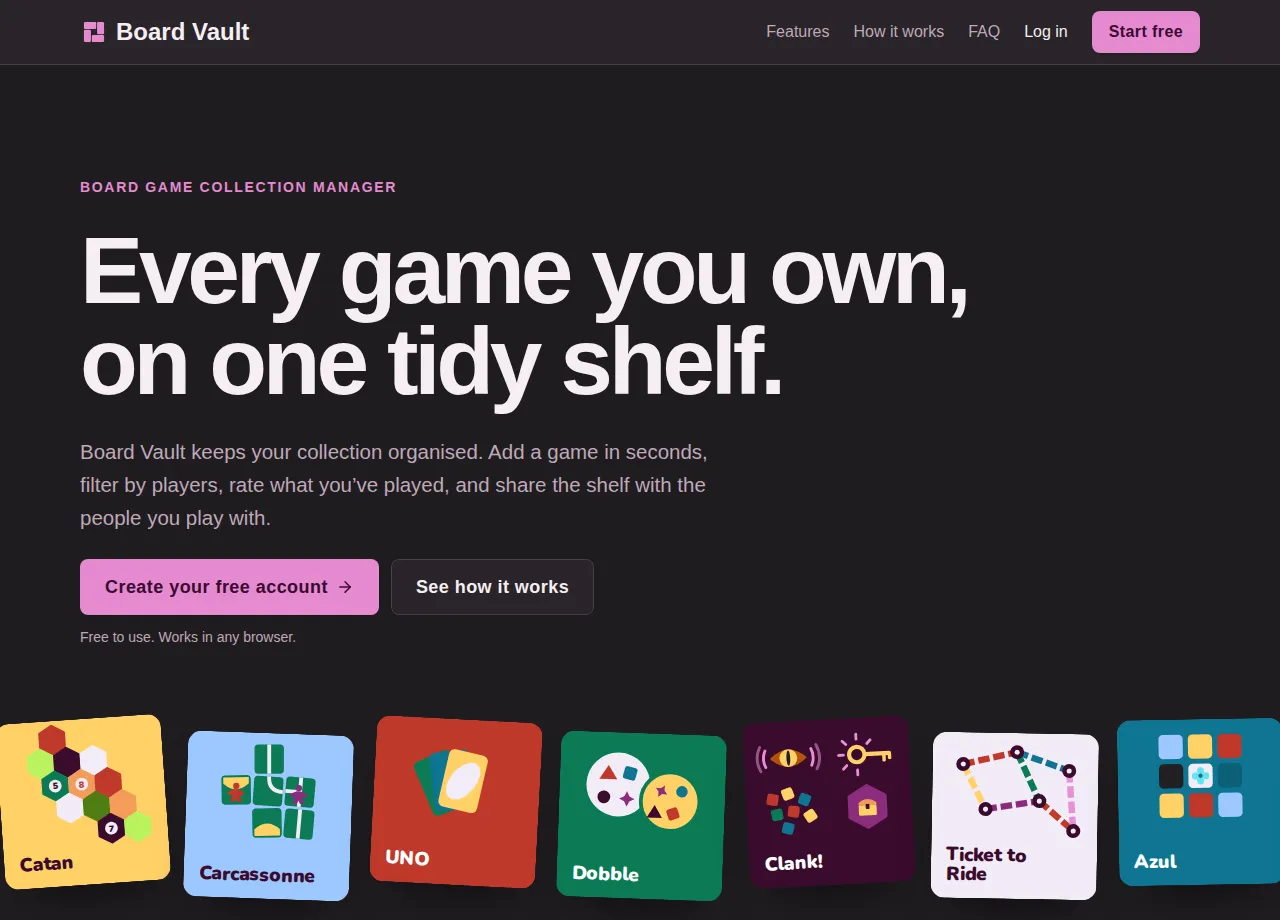
A board game companion for groups that meet regularly. Shared shelves, explainable game recommendations, game nights with RSVPs, and a history of what the group played.
- 2024 – present
- Private beta
Invite-only beta, opening registration soon.
The problem
A group that plays board games every week owns dozens of games between them, spread across everyone’s shelves. Every game night starts with the same questions: who is coming, what can we play with that many people, who has to bring it, and didn’t we play that one last time?
Board Vault answers those questions for the group, not for one person. Each person keeps a private shelf, and the group sees the shared picture: who owns what, how people rated it, and what was played.
What it does
- Personal shelves. Add a game from the catalogue, filter by player count, rate what you played, and keep a wishlist.
- Groups. Members see the group’s combined collection and who owns each game.
- Recommendations. For the people actually coming, suggest games that fit the player count and the time available, and say why each one was picked.
- Game nights. Plan a date, collect RSVPs, build a shortlist, vote, then record what was played and who won.
Key decisions
Every durable choice is written down as an architecture decision record in the repository. A few that shaped the product:
The group is the product, not the shelf. Collection tracking is a solved problem. The interesting part is the group decision: what can these people play tonight. Recommendation and session features are designed around the group and the selected attendees, and personal collections are inputs to that.
Recommendations are deterministic and explainable. No machine learning for the first release. Hard filters (player count, whether someone attending owns the game) followed by a transparent score built from ratings, duration fit and play history. Every suggestion carries the reasons it was chosen, the results are reproducible in unit tests, and there was no need for training data the product doesn’t have yet.
Own the game catalogue. Game data lives in Board Vault’s own tables. Games arrive through user proposals and admin approval. An external catalogue such as BoardGameGeek could only ever be an admin-side import, never something the app calls at request time. Game artwork follows the same rule: Board Vault stores its own copy and never hotlinks images from other sites. The app keeps working if an outside service changes or disappears, which is exactly what ended Hexastats.
One way to sign in. Authentication moved to Clerk with a migration window for the old password accounts. Once every active account was linked, the legacy path was removed entirely, with its password storage, reset tokens and email dependency. One session model to secure and test instead of two.
The night belongs to the people at the table. Only the organizer could change a game night, so if they were late, nobody could record what was played. Now anyone invited who hasn’t declined can start and finish the night and record plays, while invitations and cancelling stay with the organizer.
Engineering
- Angular frontend, NestJS API, libSQL (SQLite locally, Turso in production), optional Upstash Redis for caching and rate limits, Clerk for identity, deployed on Vercel.
- The API is the security boundary: it authenticates, authorizes and validates every request. The frontend validates every API response against a schema.
- CI runs tests and Playwright visual-regression checks against committed baselines. A scheduled workflow monitors uptime.
- Local development runs against a SQLite database with synthetic data, so working on the app never needs production access.
Status
Board Vault is in an invite-only beta. The core loop works end to end, and the next step is opening registration to everyone.
- Angular
- NestJS
- TypeScript
- Turso
- Clerk